
Coordination Has Become More Expensive Than Infrastructure.
When the cost of sensing, routing, and rule-encoding collapses, organizations that continue coordinating through meetings and approval chains accumulate structural capital inefficiency.
Core framing from The Post-Project World: When Coordination Becomes Infrastructure.
POSITIONING
OrbaOS™ is a coordination capital strategy, not a software product.
We help executives measure and reduce Coordination Capital Ratio by migrating governance and decision routing from human mediation to infrastructure.
What this is
- Executive diagnostic framework
- Coordination substrate migration strategy
- Capital allocation and operating model advisory
What this is not
- Productivity tool deployment
- Job-elimination narrative
- Ideological transformation program
OrbaOS™ is a strategic framework, not a productivity app or job-elimination strategy. Its measurement implementation — OrbaOS Instruments — produces auditable Coordination Capital Ratio and structural floor measurements for boards and audit committees, but the framework's value is independent of any software.
STRUCTURAL RISK
When Coordination Becomes a Capital Constraint
- CCR above 30–35% correlates with slower decision velocity across operating units.
- Operating leverage flattens as a larger share of labor cost is absorbed by synchronization.
- AI investment underperforms when human routing remains the dominant control mechanism.
- High performers disengage when coordination load crowds out judgment-intensive work.
- Capital allocation conversations often ignore hidden coordination absorption.
What a 13-Point CCR Reduction Means
1,000 employees
$120,000 fully loaded cost
Total labor cost = $120,000,000
CCR 35% = $42,000,000
CCR 22% = $26,400,000
Capital released = $15,600,000 annually
Optional margin example:
Revenue $500,000,000
Operating margin improves from 8.0% to 9.56% if 50% drops to bottom line.
THE THRESHOLD
The Economic Threshold
Three cost collapses are redefining organizational economics:
Sensing
-90%
Cost of sensing collapse
Routing
-95%
Cost of routing collapse
Rule Encoding
-85%
Cost of rule encoding collapse
When infrastructure coordination becomes cheaper than human-mediated coordination, legacy governance models become economically obsolete.
CORE METRIC
Coordination Capital Ratio (CCR)
CCR = % of labor cost spent on human-mediated coordination. Boards can track CCR alongside SG&A ratio, cost-to-income ratio, and operating leverage to quantify governance efficiency.
< 15%
Infrastructure-leveraged
15-25%
Coordination-loaded
25-35%
Coordination-bound
> 35%
Coordination-constrained
Measurement implementation
Run the diagnostic
OrbaOS Instruments is the platform that operationalises this framework for boards and audit committees. Thirty behaviour-anchored items produce a board-readable RSI / CDI score with explicit interpretation triggers — in roughly 90 minutes. £499 self-serve diagnostic pack, monthly platform plans for ongoing measurement.
Founder offer: every paid plan ships a hardcover edition of The Coordination Capital Doctrine (RRP £55) free.
CAPITAL REALLOCATION
Reallocate capital from synchronization to execution.
The objective is not to remove human judgment. The objective is to reduce avoidable coordination load and redeploy capital into throughput, delivery quality, and strategic capacity.
Current State
- PMO and coordination-heavy budget mix
- Management layers absorbing routing decisions
- External consultant spend for synchronization work
- Meeting load as a hidden operating cost
Future State
- Infrastructure-embedded coordination
- Decision latency compression
- Clear authority routing and exception handling
- Higher capital deployment velocity
REGULATORY COMPATIBILITY
Governance Through Rules, Not Forums
In regulated environments, infrastructure-embedded governance improves control quality:
Higher auditability
Encoded rules are more verifiable than meeting minutes and informal approval threads.
Real-time traceability
Alerts, decision logs, and authority routes generate automatic operational evidence.
AUTHORITY REDISTRIBUTION
Human work shifts from coordination to judgment.
In infrastructure-embedded organizations, human roles move toward exception handling, strategic decision-making, and cross-functional judgment.
Outcome Stewardship
Translate enterprise strategy into decision rules, guardrails, and measurable outcomes.
Flow Governance
Maintain routing logic, reduce latency, and resolve structural bottlenecks across value streams.
Risk and Rule Oversight
Embed controls directly into operating rules and handle exceptions requiring human judgment.
Strategic Authority Design
Design where authority sits, how it escalates, and where executive intervention creates leverage.
CCR Executive Brief (10 pages)
If your CCR exceeds 25%, you are coordination-bound. Download the Executive Brief.
THE BOOK
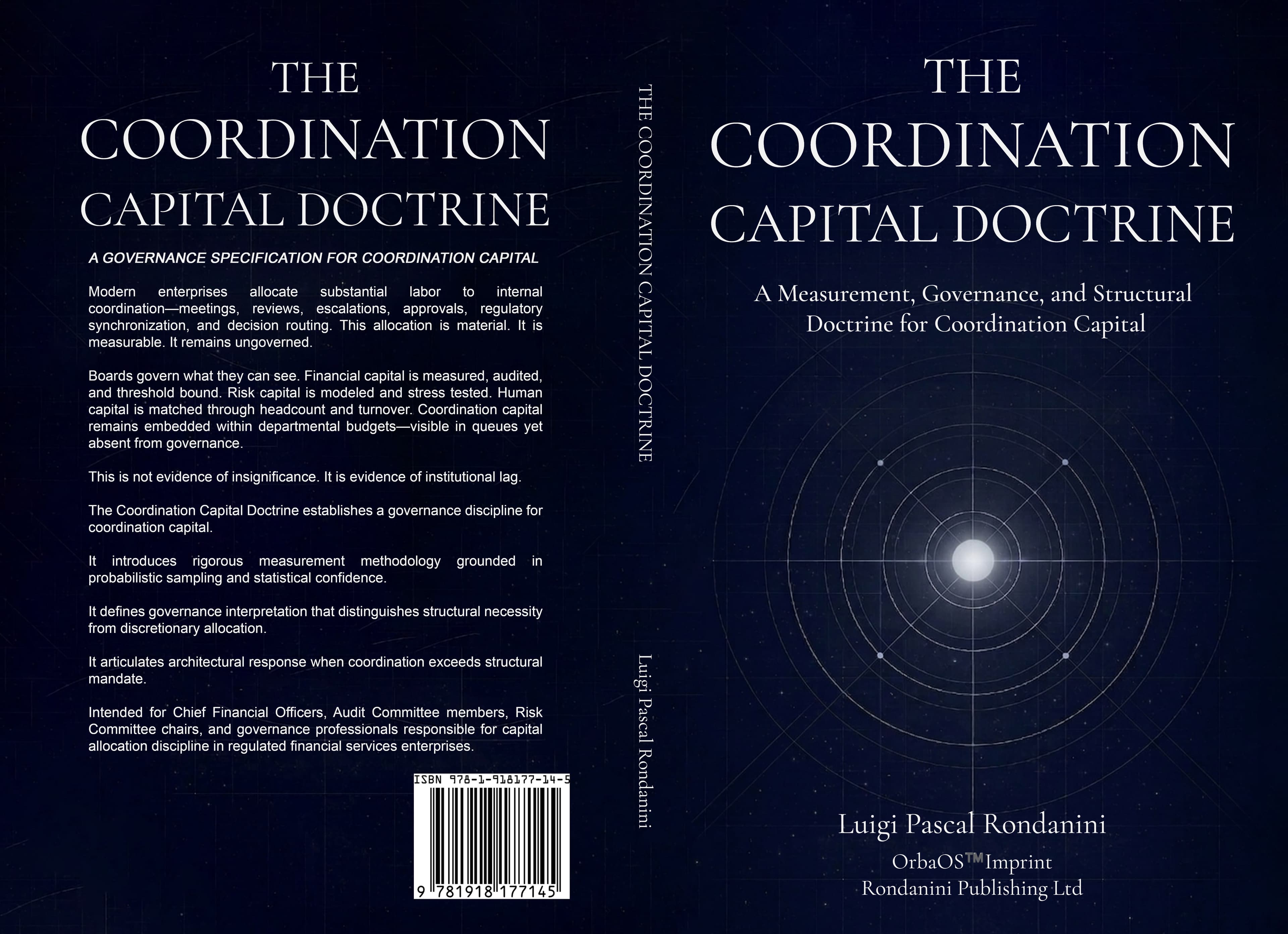
The Coordination Capital Doctrine
The first governance doctrine for coordination capital — introducing the CCR, Structural Floor, and Coordination Drift as fiduciary instruments for CFOs, Chief Audit Executives, and Risk Committee Chairs in regulated financial institutions.
The Coordination Capital Doctrine establishes coordination as a measurable, governable form of institutional capital — not a cost to be tolerated, but a structural allocation requiring the same fiduciary discipline applied to financial and operational capital.
Drawing on nearly thirty years of direct exposure to regulated financial services environments, Luigi Pascal Rondanini formalises the first governance specification for coordination capital: a doctrine that defines how coordination should be measured, governed, and reported at the board and audit committee level.
The book introduces the Coordination Capital Ratio (CCR), the Structural Floor, and Coordination Drift — three instruments that allow CFOs, Chief Audit Executives, and Risk Committee Chairs to impose governance discipline on an allocation that, in most regulated institutions, remains entirely unmeasured.
This is not a management methodology. It is a governance doctrine — designed for institutions where capital discipline is a fiduciary obligation, not a management preference.
Published by Rondanini Publishing Ltd under the OrbaOS™ Imprint.
Print / eBook — coming up.
FRTB programmes don't burn capital on math. They burn it on coordination replay.
Where to begin
If you need a baseline
Measure your current Coordination Capital Ratio and identify your threshold band.
Calculate CCR →If you need board alignment
Use the executive brief to align leadership on governance economics and migration priorities.
Read the brief →If you're ready to act
Book a CCR diagnostic to prioritize capital reallocation and migration sequencing.
Book diagnostic →